

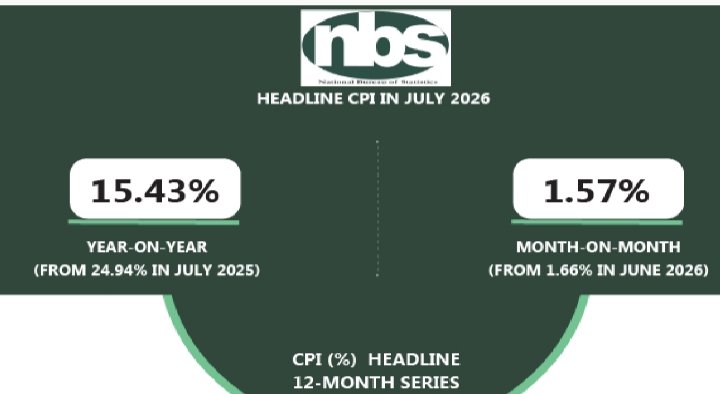

Nigeria’s headline inflation rate reduced further to 15.43 per cent in July 2026, down from 15.91 per cent in June, the National Bureau of Statistics (NBS) has said.
Food prices in Nigeria recorded their steepest month-on-month increase in recent memory in July, tempering the broader disinflation narrative that had been building.
The figures were contained in the Consumer Price Index (CPI) report for July 2026, presented by the Statistician-General of the Federation and Chief Executive Officer of the NBS, Prince Adeyemi Adeniran.
According to the report, the Consumer Price Index rose to 145.3 in July, a 2.2-point increase from the 143.0 recorded in June.
On a year-on-year basis, the headline rate has now fallen dramatically from 24.94 per cent recorded in July 2025 — a year-on-year decline of 9.51 percentage points, reinforcing the disinflation trend that has defined much of 2026. Month-on-month, the headline rate eased slightly to 1.57 per cent, down from 1.66 per cent in June.
While the headline number continued its downward glide, food inflation told a more troubling story.
The food index stood at 20.31 per cent year-on-year in July, down sharply from 26.20 per cent a year earlier, but on a month-on-month basis, food inflation surged to 5.56 per cent — up from 3.75 per cent in June, a jump of 1.82 percentage points.
The NBS attributed the spike to rising average prices of crayfish, fresh pepper, fresh onions, fresh carrots, rice, water yam, fresh tomatoes, garri, plantain, beef, eggs, guinea corn, ginger and plantain flour, among other staples — a list that reads like a snapshot of the average Nigerian household’s kitchen basket.
At the divisional level, food and non-alcoholic beverages remained the single largest driver of headline inflation, contributing 6.18 percentage points year-on-year, followed by restaurants and accommodation services (1.99 per cent) and transport (1.64 per cent).
Housing, water, electricity, gas and other fuels contributed 1.30 per cent, while education services and health added 0.96 per cent and 0.94 per cent respectively.
Core inflation — which strips out volatile agricultural produce and energy — stood at 14.97 per cent year-on-year, down from 23.95 per cent in July 2025.
On a monthly basis, core inflation slowed markedly to 0.15 per cent, from 1.66 per cent in June.
Among the newly introduced sub-indices, farm produce inflation rose 19.62 per cent year-on-year, energy inflation stood at 4.40 per cent, services at 16.00 per cent, goods at 15.33 per cent, and imported food at 13.24 per cent.
The urban-rural divide persisted. Urban inflation came in at 16.12 per cent year-on-year, while rural inflation stood at 13.77 per cent — a gap of nearly 2.4 percentage points.
On a month-on-month basis, urban inflation eased to 1.90 per cent from 2.13 per cent in June, while rural inflation rose to 0.78 per cent from 0.52 per cent, suggesting price pressures are gradually shifting toward the countryside even as cities see some relief.
State-level data revealed stark regional disparities. Adamawa recorded the highest year-on-year headline inflation rate at 33.03 per cent, followed by Yobe (25.21 per cent) and Anambra (23.99 per cent). At the other end, Nasarawa posted the lowest rate at 7.86 per cent, alongside Kebbi and Borno, both at 9.12 per cent.
On a month-on-month basis, Adamawa again led with 12.48 per cent, trailed by Anambra (9.95 per cent) and Delta (9.54 per cent), while Niger (-5.86 per cent), Enugu (-5.71 per cent) and Kebbi (-4.89 per cent) recorded outright price declines.
Food inflation followed a similar geographic pattern. Adamawa recorded the highest year-on-year food inflation at 51.36 per cent, followed by Katsina (30.84 per cent) and Zamfara (30.65 per cent), while Borno posted a rare year-on-year decline of -0.31 per cent. On a monthly basis, Adamawa again topped the food inflation chart at 17.02 per cent, ahead of Lagos (13.48 per cent) and Borno (13.26 per cent).
The 12-month average inflation rate for the period ending July 2026 stood at 16.89 per cent, a steep 12.21-percentage-point drop from the 29.10 per cent recorded a year earlier — evidence, the NBS said, of a sustained cooling in overall price pressures even as month-to-month food costs remain volatile.
The report forms part of the Bureau’s rebased CPI series, which now tracks 242 item strata across 74 population strata — the urban and rural segments of Nigeria’s 36 states and the FCT — under the 2018 Classification of Individual Consumption According to Purpose (COICOP) framework, with 2024 as the price reference year and 2023 as the weight reference period.