

The International Press Centre, IPC, has advised Nigerian journalists start reporting issues that directly affect ordinary citizens in the country.
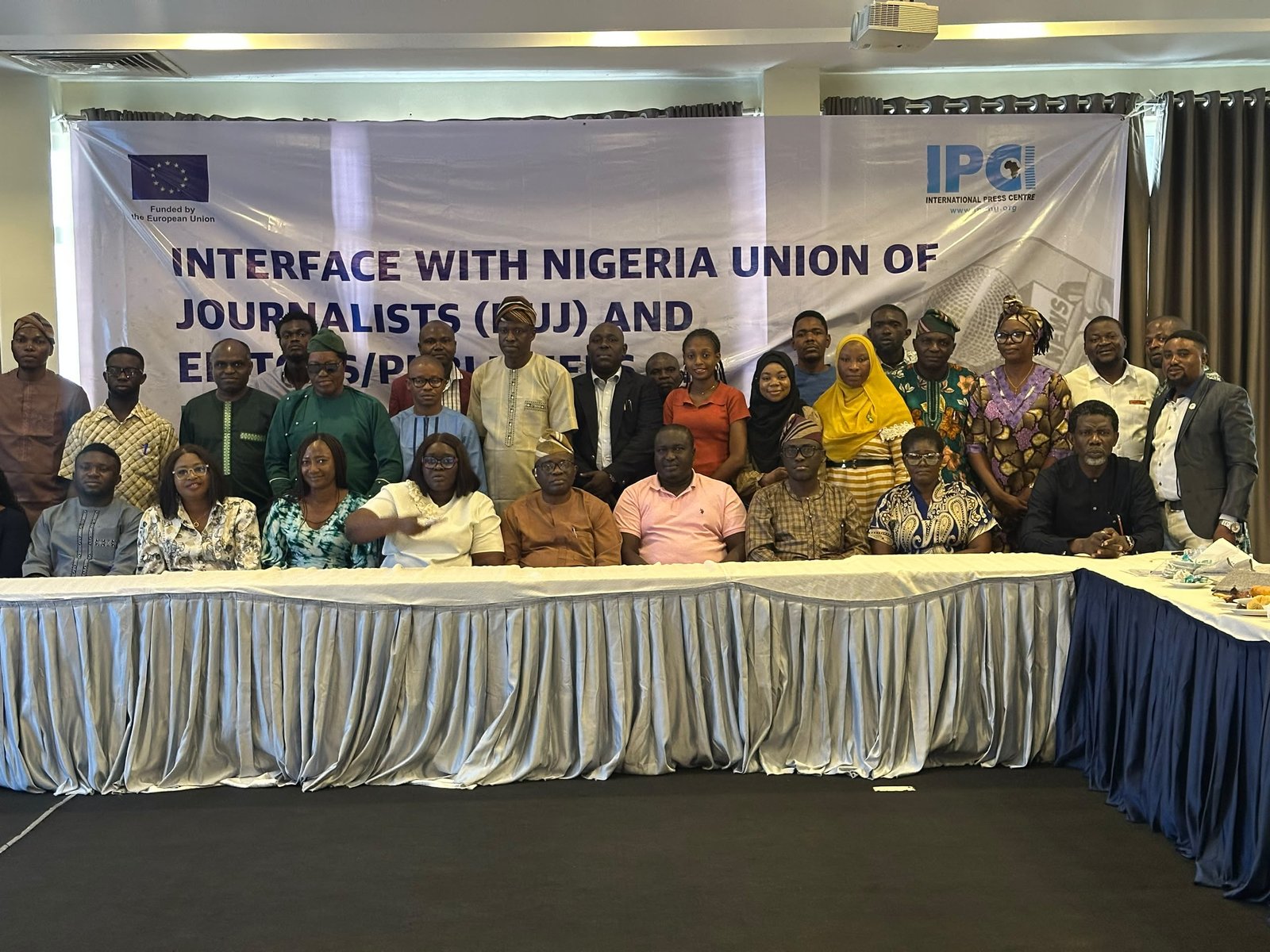
Its Executive Director, Lanre Arogundade, Programme, said this on Tuesday in Ibadan, at a day interface with the Nigeria Union of Journalists, NUJ, and capacity building programme for journalists on accountability reporting.
The programme was organised by IPC under Component 4 (Support to Media) of the European Union Support to Democratic Governance in Nigeria (EU-SDGN II).
Represented by Programme Officer Melody Akinjiyan, he said focus issued-based focus will enable the media to assess candidates’ manifestoes, verifies political claims and holds public officials accountable for performance, especially on economy, education, healthcare, security, employment and infrastructure
Besides, the concerns of women, young people, persons with disabilities and other underrepresented groups must also be reflected in public discourse if democracy must work for all.
He maintained that misinformation, manipulated content and divisive narratives could downplay public confidence in the media and democratic institutions.
He emphasized the necessity for fact-checking, accuracy, fairness and conflict-sensitive reporting to ensure that electoral coverage promotes peace in the country.
He added: ” The Nigerian media should stop chasing political rallies, defections and personalities.We must provide citizens with credible information to enable them make informed electoral decisions.”
He explained that the program was organized to enable the media to promote democratic accountability before, during and after the elections in Nigeria.
The Oyo State Chairman of Nigerian Union Of Journalists, Akeem Abass, implored journalists to examine candidates’ manifestoes and assess campaign promises against actual government performance.
He maintained that citizens deserve reliable information on issues affecting their daily lives, Abass said in an address read by his Vice Chairman, Abiodun Atilola, who also advised advised the media to ensure that speed should not defeat accuracy.
He also cautioned the media against sensationalism and compromising professional judgment for political interests
He stressed the need to deepen conflict-sensitive reporting that promotes peaceful participation and robust electoral value.
He hinted that his chapter would continue to give premium to professional development, ethical journalism, digital capacity building and responsible use of artificial intelligence in news gathering.
General Editor of Tribune Newspapers, Dr Taiwo Adisa, punctured the persistent wrong narratives with democracy promoted by lapses between campaign promises and governance outcomes.
In his presentation titled “2027 General Election in the Context of Democratic and Accountability Reporting,” he maintained that democracy remains the best model for protecting citizens’ liberties.
He advised editors and publishers to champion event-driven coverage to issue-based journalism that focuses attention on women, youth and other disadvantaged groups in the country.
He identified education, agriculture, rural roads and security as major concerns of residents in Oyo State.
He stressed need to monitor provision of agricultural inputs, improved seedlings and construction of rural roads linking communities to urban centres.
Highlighting kidnapping, banditry and farmer-herder conflicts, he lamented that Oyo had experienced its share of national insecurity.
He also spoke on local government autonomy and payment of salaries to primary school teachers, healthcare workers and pensioners.
Oyo is a politically active state where media coverage could influence political fortunes, especially with proliferation of radio stations, online TVs, podcasts and online newspapers, he stated.
He asserted issue-based reporting is critical on account of more governorship aspirants emerging ahead of 2027 and presence of APC, PDP and APM
Olusola Oludiran, a fact-checker with Nigeria Democratic Report, in his session, cautioned against loading information channels with misinformation, disinformation and false narratives which spread because they are emotionally charged and sensational.
According to him, false information can trigger violence, undermine public trust, distort electoral choices, and destroy reputations built over the years.
Newsrooms, he suggested, must create a dedicated fact-checking desks ahead of 2027 and trained participants on Google Fact Check Explorer, InVID and TinEye for reverse image and video verification.