

The Nigeria Customs Service (NCS) beat its 2025 revenue target by 10.24%, recording ₦7.277 trillion against a benchmark of ₦6.584 trillion.
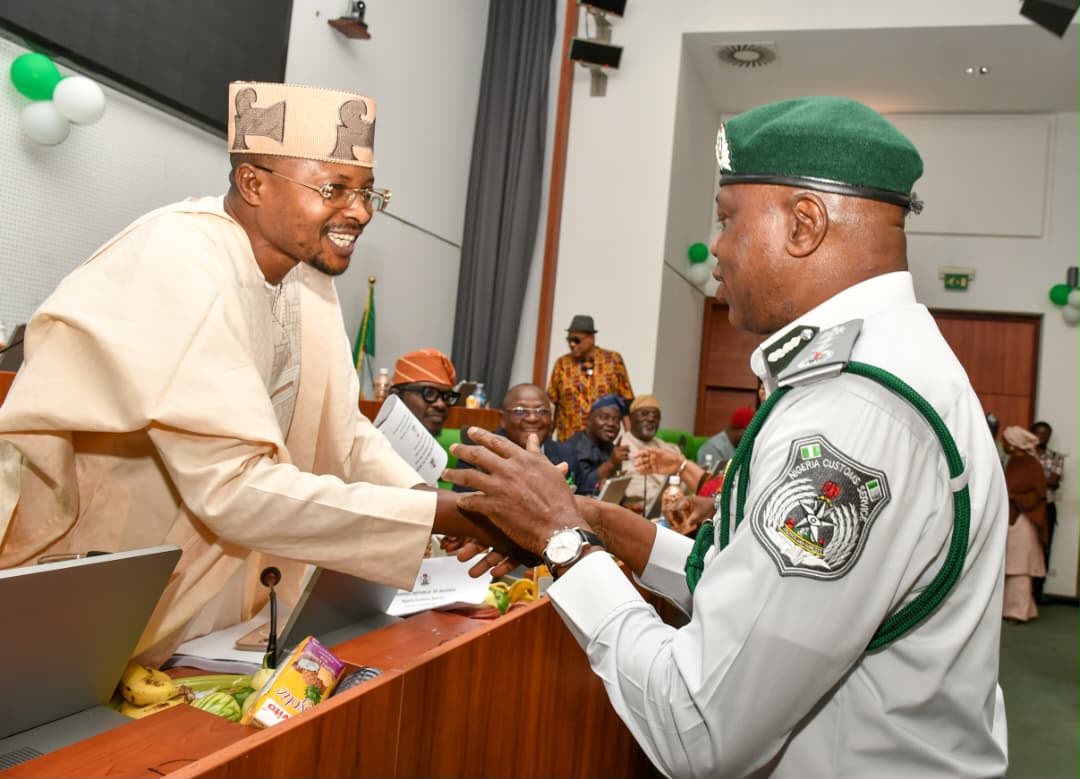
CG Bashir Adeniyi revealed this on Monday while defending the Service’s 2025 performance and 2026 proposal before the House of Representatives Committee on Customs and Excise.
He explained that the feat was recorded in spite of duty waivers and tax concessions, and credited it to reforms that strengthened revenue administration.
The Service is now targeting ₦11.074 trillion for 2026.
He said the revenue performance underscored the impact of reforms introduced by the Service to strengthen revenue administration, even as several government interventions affected Customs’ revenue outlook during the year.
“The correct revenue generated from January to December 2025 is ₦7.277 trillion. This represents a positive variance of 10.24 per cent above our annual target of ₦6.584 trillion,” he said.
According to him, the continued suspension of excise duty on telecommunications services throughout 2025 and the non-implementation of some approved tax measures, including the Green Tax, limited revenue growth.
He added that fiscal incentives introduced by the Federal Government to stimulate key sectors of the economy also had implications for Customs collections. These included waivers and concessions granted on pharmaceutical and healthcare products to improve access to healthcare, as well as duty concessions under the Presidential Compressed Natural Gas (CNG) Initiative for CNG-powered and electric vehicles.
He identified import duty exemption certificates as the most significant factor affecting revenue generation, disclosing that imports valued at about ₦34.53 trillion benefited from various waivers and exemptions during the year.
He said: “In 2025, a total of about ₦34.53 trillion worth of imports received various exemptions and waivers,” he told lawmakers, noting that the beneficiaries included military procurements and other strategic imports approved by the Federal Government.
He added that only a limited number of products remained subject to excise duty in 2025, while the escalation of tensions in the Middle East during the last quarter of the year disrupted imports of strategic commodities, particularly wheat.
The Comptroller-General said the Service had an approved budget of ₦1.132 trillion for the 2025 fiscal year but received ₦808.86 billion for implementation, representing 71.42 per cent of the approved estimate.
He explained that the shortfall arose from the transition to a new funding framework under the Nigeria Customs Service Act.
According to him, the budget was prepared on the assumption that the Service would operate throughout the year under the four per cent Free-on-Board (FOB) Cost of Collection arrangement. However, Customs continued to receive funding under the previous seven per cent Cost of Collection model until August 2025 before migrating to the new system.
“The projection for 2025 was predicated on the four per cent FOB Cost of Collection. But from January to July, we still relied on the seven per cent Cost of Collection until August when implementation commenced. This explains the variance between what was approved and what was actually available,” he said.
He commended the National Assembly for supporting the transition to the new funding model.
“We want to put it on record that the support we received from the National Assembly was very instrumental, and we thank you for this.”
The Customs chief said the available funds were deployed to personnel costs, overhead expenditure, capital projects and concessionaire fees.
A member of the committee, Hon. Alex Ifeanyi Mascot Ikwechegh, representing Aba North/Aba South Federal Constituency of Abia State, questioned whether the ₦1.132 trillion represented actual expenditure or merely the approved budget.
He also asked the Customs management to explain the concessionaire fees contained in the expenditure breakdown and reconcile the figures presented to the committee.
Adeniyi explained that the ₦1.132 trillion represented the approved budget and not actual receipts.
He further clarified that concessionaire fees, which were previously paid from the Comprehensive Import Supervision Scheme (CISS) account managed outside the Service, had become the responsibility of the Nigeria Customs Service following the abolition of the CISS account.
“Under the new Act, the responsibility for payment of concessionaire fees was transferred to the Nigeria Customs Service, and these fees are now paid from the four per cent FOB Cost of Collection. Twenty-five per cent is reserved to meet those obligations,” he explained.
Presenting the Service’s projections for 2026, Adeniyi disclosed that Customs had been assigned a revenue target of ₦11.074 trillion, comprising ₦5.542 trillion from federation accounts, ₦1.491 trillion from non-federation accounts, ₦2.273 trillion from import Value Added Tax (VAT) and ₦1.26 trillion from the four per cent FOB Cost of Collection.
He said the Service intends to achieve the target by deepening the deployment of technology, strengthening post-clearance audit mechanisms, expanding intelligence-led enforcement operations and improving trade facilitation.
According to him, the B’Odogwu Unified Customs Management System has become the backbone of the Service’s modernisation programme.
“The Unified Customs Management System is now up and running very well. We believe it provides the platform for robust revenue collection,” he said.
Adeniyi also highlighted reforms to the Post Clearance Audit system undertaken in collaboration with the International Monetary Fund (IMF) and the World Customs Organization (WCO), saying the initiative had enhanced real-time system audits and revenue recovery.
“Through that, we are able to carry out real-time system audits and continue to recover revenue on a daily basis.”
He added that the Authorised Economic Operator (AEO) Programme and the Advance Ruling Programme had become fully operational and were expected to improve compliance while facilitating legitimate trade.
The Comptroller-General, however, cautioned that although new excise measures introduced under the 2026 Fiscal Policy would boost revenue, recently approved tariff reductions could moderate collections.
He confirmed that import duty on used vehicles had been reduced from 15 per cent to five per cent, while duty on brand-new vehicles had been cut from 20 per cent to 10 per cent.
Welcoming the policy, the committee chairman said Nigerians should be made aware that the Federal Government had taken deliberate steps to reduce the cost of vehicle importation.
Another lawmaker, however, questioned why many importers continued to route cargo through neighbouring countries despite the lower tariffs.
Responding, Adeniyi explained that the policy only recently came into effect.
“This is a new policy. It takes an average of about 90 days before we begin to see its full effects. The implementation commenced on May 1, 2026, and we believe the impact will become more evident over time.”
He stressed that while Customs advises government on trade trends and revenue implications, responsibility for fiscal policy rests with the Federal Ministry of Finance.
“Implementation of fiscal policy measures is outside the mandate of the Nigeria Customs Service. We periodically review developments, make observations and forward recommendations through the Ministry of Finance. Government then takes the final decision.”
Adeniyi noted that intervention programmes introduced by the Federal Government since 2024, including incentives for healthcare products, CNG vehicles and other strategic sectors, remain in force, adding that although such measures reduce Customs revenue in the short term, they are intended to support broader economic objectives.
On the expenditure proposal for 2026, the Comptroller-General said the Service proposed ₦421.70 billion for personnel costs, ₦307.77 billion for overhead expenditure and ₦565.93 billion for capital projects.
He disclosed that Customs currently has 15,969 personnel, while 3,927 additional recruits are expected before the end of the year.
According to him, personnel allocations will cover salaries and statutory obligations, while overhead expenditure will finance logistics, training, ICT infrastructure, maintenance of operational assets and security operations. Capital expenditure, he added, will focus on completing ongoing projects, procuring operational equipment and settling existing contractual commitments.
Adeniyi appealed to lawmakers to give favourable consideration to the Service’s 2026 budget proposal.