
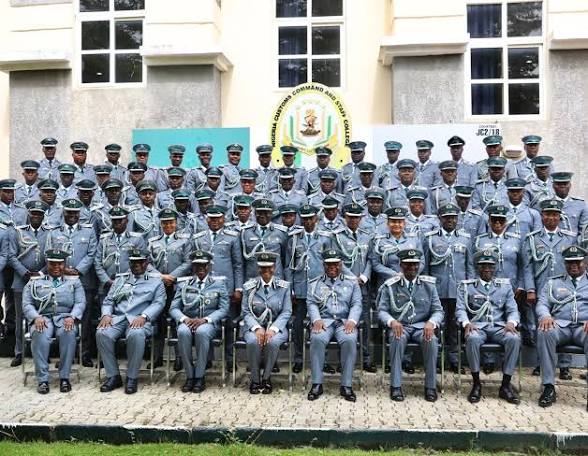

The Nigeria Customs Command and Staff College (NCCSC), Gwagwalada, Abuja, Nigeria’s Federal Capital Territory (FCT), has begun Computer-Based examination for Senior Course students, marking a transition from the traditional handwritten examination system to a fully digital assessment process.
The development forms part of the institution’s broader drive to align Customs training and academic procedures with modern technology and global professional standards.
The Commandant of the College, Assistant Comptroller-General of Customs (ACG) Dow Gaura, described the transition as a necessary response to the evolving realities of modern Customs administration.
The College, as the intellectual hub of the Nigeria Customs Service (NCS), cannot afford to remain tied to outdated academic processes at a time when Customs operations globally are becoming increasingly technology-driven, he said.
According to him, the old handwritten examination method created avoidable delays in assessment, especially where illegible scripts made marking difficult for directing staff.
“We are now in the era of Artificial Intelligence and digital transformation. As the think tank of the NCS, the College must lead from the front. We cannot continue to preach technology without embracing it ourselves,” he said.
He explained that, under the previous system, directing staff sometimes spent several days marking examination scripts due to handwriting challenges and the volume of papers handled across syndicates.
“In the past, examinations and assignments were handwritten. Some scripts came with illegible handwriting, making it difficult for the directing staff to assess them properly. Today, our students write and submit examinations electronically through the system. It is faster, more transparent and more efficient,” he added.
He further disclosed that beyond examinations, the College has gradually integrated technology into other aspects of academic engagement, including revision sessions and virtual learning interactions conducted through digital platforms.
He also stressed that sustainability remains one of the College’s strongest advantages, noting that many members of the directing staff are selected from among the institution’s top graduating students.
“One important advantage we have is continuity. These officers already understand the College’s vision and academic philosophy. They inherit the structure, improve on it and pass it on to the next generation,” he said.
He added that character remains a major consideration in selecting directing staff, stressing that professionalism within the College extends beyond academic performance alone.
“Our directing staff represent the best in learning and character. An officer may be brilliant academically, but if the character does not align with the standards of the College, such an officer cannot become a directing staff,” he stated.
On the future of Customs training, Gaura said the institution is already advocating stronger computer literacy requirements for officers attending courses at the College.
According to him, digital competence has become unavoidable in modern Customs operations, and officers must prepare themselves for the changing realities of international trade administration and border management.
“The future of Customs operations is technology-driven, and officers must prepare themselves for that reality,” he said.
He also commended the Comptroller-General of Customs (CGC), Dr. Bashir Adewale Adeniyi, and the Customs Management Team for their continued support towards infrastructural and academic improvements within the College.
“The transformation is visible everywhere. Hostels are being renovated, the cafeteria is being expanded, the museum is receiving attention, and several projects are ongoing within the College,” he added.
Also speaking, the Deputy Commandant and Director of Studies, Comptroller Haniel Hadisson, described the introduction of computer-based examination as one of the most significant academic reforms in the history of the institution.
According to him, the initiative goes beyond replacing paper with computers, as the real objective is to prepare officers for modern professional realities within the Customs administration.
“What we are witnessing today is a major academic transition in the history of the College. The introduction of Computer-Based examination is about preparing officers for modern Customs administration,” he said.
Comptroller Hadisson disclosed that both students and directing staff underwent orientation sessions, practical engagements, and system testing ahead of the examinations to ensure smooth implementation.
He noted that the pioneer students participating in the exercise have now set a standard for future courses within the College.
The Chief Instructor of the Senior Course, Assistant Comptroller of Customs (AC) Isaac Akano, said students adapted quickly to the new system after initial concerns associated with moving away from handwritten examinations.
“At the initial stage, there were concerns from some students who were more familiar with the traditional handwritten method. But after the orientation and practical sessions, confidence grew significantly,” he said.
He explained that the Computer-Based examination system has already improved coordination, monitoring, and assessment within the College, while also allowing students to focus more on content delivery rather than script presentation and handwriting issues.