

An Adamawa scholar, Dr. Faisal Hamman, 25, has earned a doctorate in Electrical and Computer Engineering from the University of Maryland.
Speaking on their son’s feats, his parents, Adamu Hamman and Aisha Adamu Hamman, both engineers, disclosed that :”We noticed his special gift early. He consistently won awards in Mathematics, Further Mathematics and Physics in secondary school.
“As early as Primary Three, his teacher told us he was gifted. And by the time he was in senior secondary school, his excellence was undeniable” the parents stated.
Faisal graduated from high school with nine distinctions (7A1s and two B2s) in WAEC Certificate exam in 2016, a time they faced a pivotal decision.
The parents said: “We wanted a stable academic environment that would stretch his abilities, adding that it was the choice that led them to send him to Turkey for university studies.
“We reviewed his options carefully. We wanted the best environment for him, his father said.
In Istanbul, he graduated summa cum laude in Electrical and Electronics Engineering, emerging as overall best graduating student with a near-perfect GPA.
He would later move to the United States to pursue graduate studies at the University of Maryland, one of America’s leading engineering institutions.
According to Dr. Hamman, “I have always enjoyed solving complex problems through mathematics and engineering”.
AI, he explains, felt like a natural extension of that passion, combining theory, data and computation to build systems that can reason and learn.
His doctoral research focuses on what experts call “trustworthy and reliable machine learning”.
He develops mathematical and computational tools to ensure AI systems remain accurate, transparent and capable of signaling uncertainty when unsure.
“Explainability is no longer optional” he said, stressing that “As AI becomes embedded in daily life, it is essential for safety, accountability and public trust”.
During his PhD, he presented his research at some of the world’s most competitive AI conferences, including NeurIPS, ICML and ICLR. He also published at ACM FAccT and the IEEE ISIT – venues known for rigorous global peer review.
Presenting alongside researchers from leading AI laboratories such as OpenAI, Google and Meta was a defining experience. It affirmed that a young scholar from northern Nigeria was contributing to the global conversation on AI safety and alignment.
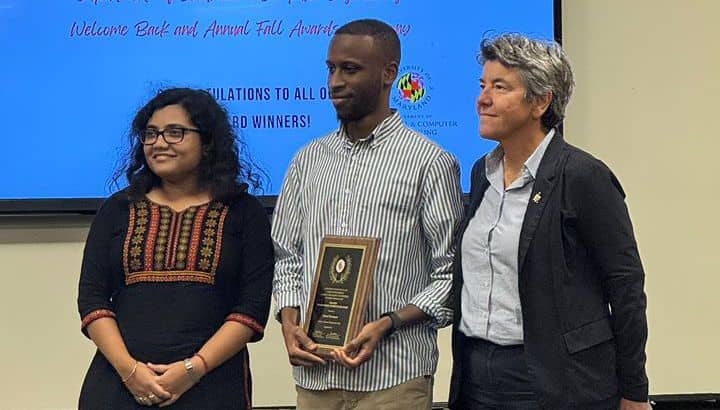
His academic excellence earned him multiple prestigious awards at Maryland, including the Distinguished Dissertation Fellowship, the Ann G. Wylie Dissertation Fellowship and the Clark School Doctoral Dean’s Research Award, honours reserved for a small number of top doctoral graduates. He also received awards for teaching excellence, reflecting a commitment not only to discovery but to mentorship.
When his parents learned that their son had earned a PhD at 25, the moment felt surreal. “It was a moment of deep pride and gratitude. We remembered the sacrifices, prayers and years of effort. It was more than a degree. It showed the kind of person he had become”.
According to the parents, “We hoped he would do well, but this exceeded our expectations. Sometimes it still feels like a dream. We remain very thankful to Allah”.
The achievement carries symbolic weight for the community in Gombi, Adamawa state.
“It brings hope. It proves that background does not limit success. Our children can compete globally” the father said.