
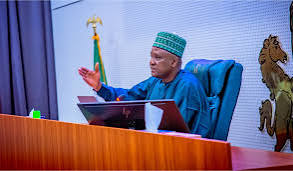

Speaker of the House of Representatives, Rt. Hon. Tajudeen Abbas,says the House is currently handling 567 active petitions relating to unlawful job dismissals, rights abuses, and various grievances brought forward by Nigerians.
He spoke on Tuesday in Abuja during his mid-term report at the ongoing House of Representatives Open Week.
He said, through the Public Petitions Committee, the House received 621 petitions on issues such as unjust job terminations and infringement of civil rights.
Hitherto, 24 have been fully processed and reports submitted, while 30 were dismissed for lack of merit, he said.
According to him, the remaining 567 petitions are in different phases of hearings and investigations, with some already debated on the floor and recommendations made.
He provided a comprehensive overview of the House’s legislative activities over the last two sessions, pointing to increasing efficiency and output.
“In just two years, the House introduced 2,263 bills, out of which 1,478 have passed second reading. Additionally, 135 are awaiting further legislative action, and 339 have been sent to Standing Committees. While five bills were rejected, 2,204 of the total came from members, with 26 from the executive and 33 transmitted from the Senate for concurrence. This demonstrates consistent legislative growth since 1999.”
Abbas disclosed that as of June 30, 2025, a total of 237 bills had been passed by the House, with 55 of them signed into law by the President.
He revealed that key legislations passed include the restructured tax laws—such as the Nigeria Tax Act and the Joint Revenue Board Act—aimed at simplifying and unifying the country’s tax system across all levels of government.
Other significant laws passed,he said, include the Electricity Act (Amendment) 2023, which moved electricity matters to the concurrent legislative list, enabling states to participate in power generation and distribution, and the Student Loans (Access to Higher Education) Act 2024, which created an autonomous Nigerian Education Loan Fund to improve access to tertiary education.
He spoke on national security, noting the passage of the Control of Small Arms and Light Weapons Act, which establishes a national centre to tackle the proliferation of illicit firearms. He also cited reforms in the defence and cybercrime sectors through the Defence Industries Corporation of Nigeria Act 2023 and the Cybercrimes (Prohibition and Protection) (Amendment) Act 2024.
He commended the House for taking a development-driven approach, especially through the passage of bills establishing development commissions across Nigeria’s six geopolitical zones.
“These commissions are designed to address region-specific challenges and drive inclusive growth. The National Minimum Wage (Amendment) Act 2024 increased the minimum wage, while the Nigeria Police (Amendment) Act 2024 sought to professionalise the police force. We also passed amendments to the Finance Act and Judiciary Office Holders Act to align fiscal and judicial reforms with national needs.”
He added that reforms extended to the financial and educational sectors, including the Central Bank of Nigeria (Amendment) Act, the Nigeria Anti-Doping Act 2025, the Investments and Securities Act 2025, and several laws establishing new universities and specialised institutions.
On constitutional reforms, Abbas disclosed that 109 amendment bills are currently under consideration, spanning areas such as electoral integrity, judiciary independence, and inclusive governance.
“Twelve bills focus on electoral reforms like synchronising general elections into a single day, enabling independent candidacy, and creating a separate commission for local government elections. Twenty-one bills seek to strengthen the judiciary through improved appellate procedures and independence,” he explained.