
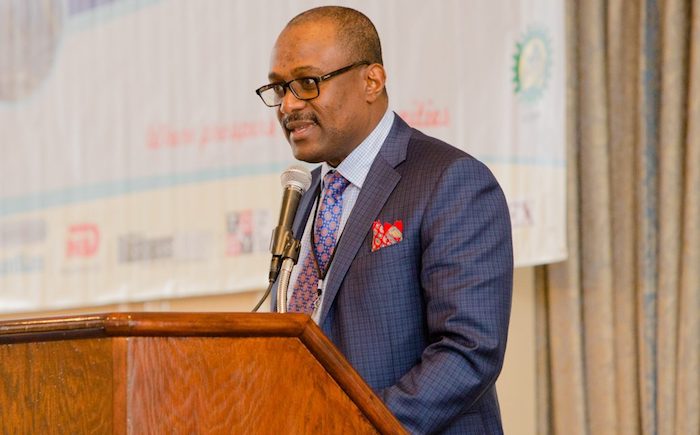

Mohammed Shosanya
Executive Secretary,Nigerian Content Development and Monitoring Board,Simbi Wabote,has appealed to the incoming administration not to discontinue decade of gas programme in Nigeria.
He said the development was necessary on the strength of the gains of the programme to the nation’s economy
He spoke recently at the Nigerian International Energy Summit (NIES) held at Abuja where he made separate presentations on Local Content Investment and Sustainable Energy Future and Building Local Content and Capacity for Realization of Nigeria’s Decade of Gas.
He said: “It is possible that the incoming government will give the programme a new name but we must not lose focus on the importance of gas to our energy needs and economic development.”
He advocated the need for annual status reporting by all concerned entities on the implementation of the Federal Government’s Decade of Gas Programme.
He emphasized that the report should highlight the successes, issues, support required, and target completion dates,adding that the reports would be prepared by agencies, entities and stakeholders that are responsible for the various projects and initiatives identified in the Decade of Gas programme and presented at the NIES which holds annually at Abuja.
Wabote implored stakeholders not to get distracted or lose steam in the implementation of the programme even as a new administration is set to assume office next month.
He also spoke on eight focus areas the board was utilizing to drive the realization of the decade of gas initiative of the government, which include Human Capacity Development, Construction of Industrial Parks, Public-Private Partnerships and Nigerian Content Intervention Funds. Others are Research and Development, Regulatory Framework, Regional Collaboration, and Enabling Business Environment.
On the capacity building programmes required to enhance the training and re-training of capable workforce for the industry, Wabote explained that NCDMB had “delivered close to 14 million manhours of training for acquisition of various skill sets required to explore, develop, operate, and maintain hydrocarbon facilities.”
He enumerated some of the board’s human capacity development tools and programmes to include the Expatriate Quota Management System, STEM Education, Technical and Vocational Education Training, Institutional Strengthening, ICT Centres, and Training Certifications.
He stated that the board’s capacity-building programmes were impactful and acknowledged internationally, adding that the survey carried out by African Petroleum Producers Organisation (APPO) to assess the standards in training institutions on the African continent rated Nigeria as one of the top countries with credible institutions for training the required manpower for the oil and gas industry.
Speaking on the updates on the construction of oil and gas industrial parks, Wabote said the board had commenced issuance of allocation letters to credible investors in readiness for the commencement of operations within the NOGAPS Industrial Parks located in Bayelsa and Cross River States.
He added that:“the NCDMB Gas Hub at Polaku is fully dedicated to domiciliation of gas related enterprises such as Pressure Reduction and Metering Station, CNG mother stations, LPG cylinder manufacturing plant, gas processing facilities, power plant, and other similar facilities.”
Speaking on the theme of the summit, ‘Global Perspectives for a Sustainable Energy Future’, Wabote said the challenges of energy transition “have brought to the fore the need for every nation to leverage its own comparative cost advantage by developing the energy resources that it has in relative abundance”, adding that “most countries including Nigeria have a mix of these resources, and they must apply local content investments to realise sustainable energy future.”
He described local content development as a philosophy that seeks to encourage the utilization of local resources such as humans, goods, services, oil, gas, wind, hydro, or solar while at the same time promoting in-country domiciliation of value-adding activities.
He added that narratives around energy transition have shifted significantly from energy swap to energy mix and this was because of the factual recognition that all forms of energy are important rather than demonizing one form of energy against the other,because some nations have depleted their reserves of certain energy sources.