


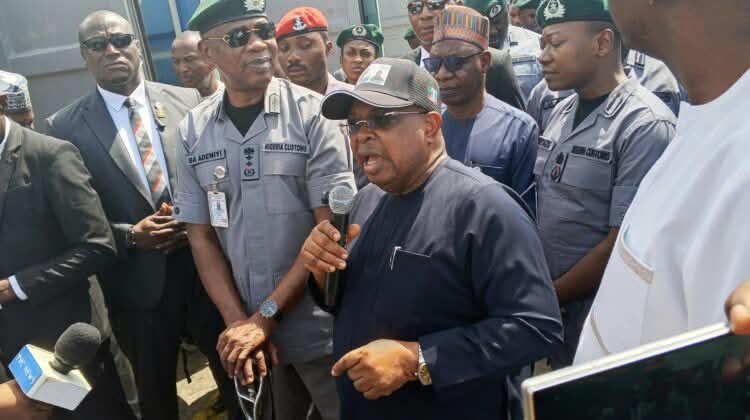


Engineers have commenced the verification and assessment of power sector equipment abandoned at Nigerian ports for 20 years to determine their condition and determine their suitability for deployment.
The Minister of Power, Joseph Tegbe, disclosed this at a press conference he co-addressed with thrb Comptroller-General of Customs, Bashir Adewale Adeniyi, on Friday in Lagos to mark the commencement of evacuation of over 300 containers of power sector equipment abandoned at Nigerian ports.
He disclosed that due to the evacuation, engineers had commenced verification and assessment of the recovered equipment to establish their condition and determine their suitability for deployment.
He hinted that some of the equipment would be transported to project locations across the country, including Kaduna, Akure and Lafia, among other destinations, to support ongoing power infrastructure projects.
According to him, the recovered materials would be matched with the requirements of specific projects to ensure their effective utilisation and prevent further waste of public resources.
He described the development as a significant milestone in the government’s efforts to address longstanding challenges affecting the power sector.
He stated that the long stay of the equipment in the ports caused considerable economic and operational costs on the country, while delaying critical infrastructure projects and putting additional pressure on existing facilities.
He lamented that the development had not only increased the financial burden on government and relevant institutions but also slowed the delivery of essential services to businesses, households and communities.
He tied the successful commencement of the exercise to the intervention of President Bola Ahmed Tinubu and the cooperation of relevant government institutions and security agencies.
According to him, the government had adopted a coordinated approach involving relevant institutions to ensure that the evacuation was carried out in line with established procedures and security requirements.
He maintained that the government remained committed to ensuring that the exercise translated into tangible improvements in electricity supply rather than merely moving stranded equipment from one location to another.
He emphasized the need for discipline, transparency and accountability in the implementation process, assuring Nigerians that the government would provide clear information on the progress of the exercise.
He further noted that recovering the equipment was only one aspect of the broader efforts required to address Nigeria’s electricity challenges.
He identified adequate fuel supply, improved operational performance and a stronger electricity transmission network as essential components of the government’s strategy to deliver reliable power to households, businesses and social institutions.
Also speaking, the Comptroller-General of Customs, Bashir Adewale Adeniyi, disclosed that the Service said it has started the process of clearance and release of the equipment
He said the exercise, which includes the waiver of accumulated port charges and demurrage, was aimed at unlocking critical infrastructure projects and accelerating the Federal Government’s efforts to improve electricity generation, transmission and distribution.
He disclosed that the first batch of 44 containers would be released from ENL terminal, while additional 54 consignments at other terminals, including Tin Can Island Port, would also be cleared.
He explained that the equipment, imported for critical government power projects, included hydropower platforms, cables, switchgears and other transmission infrastructure required by agencies such as the Transmission Company of Nigeria and Niger Delta Power Holding Company.
According to him, the equipment had remained at the ports for between 14 and 20 years, thereby delaying the execution of projects designed to strengthen Nigeria’s electricity infrastructure.
“Following a presentation by the Honourable Minister of Power to the Federal Executive Council, Mr President directed the immediate clearance of the equipment. He also directed that relevant agencies resolve all outstanding charges and administrative bottlenecks without delay,” Adeniyi said.
He said the Service had introduced several trade facilitation measures to accelerate the process, including priority processing of the consignments, deployment of dedicated officers for joint examinations and implementation of approved waivers on accumulated charges.
He said the intervention was consistent with the Tinubu administration’s robust electricity sector reforms, which were designed to attract investment, expand power generation capacity and improve electricity supply to households, businesses and industries.
He recalled that the Electricity Act 2023 had opened up the electricity market to states, allowing them to generate, transmit and distribute electricity, while the Presidential Power Initiative with Siemens Energy was being implemented to expand the country’s transmission capacity.
He added that the Federal Government had also taken steps to settle verified legacy debts in the power sector, address the metering gap and extend off-grid electricity solutions to underserved communities, universities, markets, hospitals and port terminals.
“The direction is very clear: we generate more power and move it efficiently through the grid, and deliver it to homes, businesses and industries. Every agency of government has a role to play in achieving that goal,” he said.
He expressed concern over a disturbing pattern of contractors importing equipment for government projects but abandoning the consignments at the ports without completing the projects for which they were engaged.
He warned that such practices were undermining national development, denying Nigerians access to essential infrastructure, employment opportunities and improved public services.
According to him, contractors who collect payments for government projects but fail to execute them while abandoning imported equipment at the ports should be treated as economic saboteurs.
“This exercise that we are undertaking has exposed a troubling pattern. Some contractors awarded government projects import equipment and abandon them at the ports, failing to execute the projects for which the equipment was brought into the country,” he said.
“The power sector has not been spared from this particular problem. Such contractors deny Nigerians the electricity, the jobs and the services these projects are meant to deliver,” he added.
He disclosed that the Customs Service would work with relevant government agencies and oversight institutions to identify contractors responsible for abandoned consignments, including equipment imported under government-funded projects and donations from international organisations.
He said the Service would make relevant information available to ensure that those responsible were identified and held accountable.