


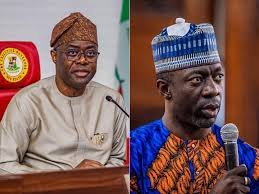


By Dapo Falade
The race toward the 2027 elections, particularly the governorship contest in Oyo State, has already begun generating significant ripples across the media landscape. This is unsurprising, given the three major dynamics shaping the contest.
First is Governor ’Seyi Makinde’s determination to ensure continuity in governance. Second is his ambition to make history as the first sitting governor in Oyo State to successfully produce and swear in his successor. Third is the opposition’s struggle to wrest power from an incumbent who will complete his two-term tenure on 29 May 2027.
Unfortunately, the media war surrounding the 2027 governorship election has taken a troubling turn. Rather than focusing on issues, the discourse has veered into pettiness, making Oyo State appear like a political spectacle to observers across Nigeria.
The opposition, particularly the All Progressives Congress (APC), has plunged deep into mudslinging and unverifiable accusations instead of presenting a credible alternative vision for governance. Their fixation on attacking Governor Makinde has become glaring, and their tactics increasingly desperate.
APC’s governorship candidate, Senator Sharafadeen Alli, popularly referred to by many in the state as Senator Billboard, has amplified a refrain once popularised by former Governor Adebayo Alao-Akala: ọ̀tá ẹni kìí pa òdù ọ̀yà (one’s enemy will never acknowledge one’s success, no matter how obvious).
Rather than conducting an honourable, issue-based campaign, the APC has chosen to discredit the widely acknowledged achievements of the Makinde administration.
Their allegations, often shallow and frivolous, collapse easily when confronted with facts. The people of Oyo State are discerning; they know better.
Adekanmbi: The Real Target
The APC’s persistent vituperations are not merely aimed at Makinde! they are strategically targeted at the governorship candidate of the Allied People’s Movement (APM), Honourable Bimbo Adekanmbi.
Governor Makinde has repeatedly demonstrated competence and resilience. Despite the mud thrown at him, his popularity and acceptance continue to grow across the state. What unsettles the APC even more is the calibre of the man they seek to discredit.
Adekanmbi, formerly part of the APC fold, has become a formidable force. Brilliant, grounded, and highly cerebral, he is several steps ahead of his detractors. While they engage in theatrics, he is traversing the nooks and crannies of Oyo State, preaching the gospel of sustainable development and responsible governance.
A grassroots politician with strong native intelligence, Adekanmbi is armed with data, policy insight, and a clear roadmap for building on Makinde’s unprecedented achievements and elevating Oyo State further.
Beyond The Theatrics: Nigerians Are Watching
Contrary to the narrative being pushed by Senator Alli and the APC leadership, the people of Oyo State – and Nigerians at large – are fully aware of the party’s track record. Many commentators across the country, citing widespread hunger, poverty, and hardship, have warned that the 2027 elections will be far from a stroll in the park for the APC or President Bola Tinubu.
What new direction does the APC hope to offer Oyo State in 2027? Will the people willingly embrace the same malaise evident at the national level and in many APC-controlled states?
Nigerians Taking APC To The Cleaners
The President and APC leadership continue to tout reforms and supposed achievements as evidence that Nigeria is on the right path. Yet, the lived reality tells a different story. Millions of Nigerians, over 60 per cent of the population, struggle to relate to these claimed successes.
The cost of living has risen astronomically. As columnist Blaise Udunze noted in Newscoven.com, the government’s reforms appear starkly at odds with the harsh economic conditions Nigerians face daily.
As Governor Makinde aptly described, Nigerians cannot continue to survive under a voodoo economy. Over 200 million citizens cannot live on paper-based claims of progress while their lived experiences reflect deepening hardship.
Reflections on Governance and the Nigerian Reality
Governor ’Seyi Makinde captured the national mood succinctly in the latest edition of his bi-monthly newsletter, The Business of Governance, when he wrote:
“As we journey down the road to 2027, you will hear many statistics about Nigeria… GDP growth. Inflation dropping. Foreign reserves increasing. Government revenue increasing. Foreign investment increasing. I believe strongly in making decisions based on data, science and logic. But numbers must translate into something people can feel in their everyday lives.”
He then posed the critical questions:
“What does economic growth mean to the Nigerian who can no longer afford three meals a day? What does increased government revenue mean to the business owner who cannot afford to keep the lights on? What does prosperity mean if the average Nigerian cannot feel it?”
Makinde’s point was simple and apt:
“When governments speak about progress, Nigerians must be able to look at their own lives and say: Yes, I can see it. I can feel it. My life is better.”
Before the Oyo APC and its foot soldiers dismiss Makinde as an “enemy,” they should take time to read what Senator Babafemi Ojudu—one of their own chieftains and a former close ally of President Bola Tinubu—wrote in his open letter to the President on Independence Day, 1 October 2026.
Ojudu, a respected journalist and former aide to Vice President Yemi Osinbajo, offered a sober assessment of Nigeria’s condition. He wrote plainly that life has become extremely difficult for ordinary Nigerians.
He explained that he felt compelled to write because the President needed “to hear, plainly and from someone who wishes you well.”
Drawing from conversations with people across the country, Ojudu wrote:
“People are struggling to afford food, medicine, rent, school fees and transport. Many have adjusted their lives as far as they can and still cannot make ends meet. For those who earn anything at all, their earnings buy less and less.Hardship has become the defining experience of too many Nigerians.”
He acknowledged that the government may claim progress based on certain indicators, but insisted that the real question is whether such progress is felt in the average household: “A parent who cannot pay school fees or buy medicine cannot live on a projection of future relief. Progress must mean food on the table, a child in school, treatment for the sick and a reasonable chance to earn a living.”
He urged the President to review policies with ordinary households in mind and to deliver prompt, measurable relief.
Ojudu warned the President against relying on sycophants:“The months ahead will test you as a leader and as a candidate seeking another mandate. More consequentially, they will test our country.”
He advised widening the circle of advisers: “Seek out Nigerians of goodwill from every part of the country, including those who disagree with you. Invite them to speak freely about what is working, what is failing and what needs to change.”
He stressed the importance of honest feedback: “A leader gains little from advisers who shield him from unwelcome news. He gains much from those willing to tell him the truth while there is still time to act on it.”
He concluded with a powerful reminder: “You have every right to ask for a renewed mandate. The Nigerian people have every right to weigh that request against their lived experience. Listen closely to the people, reconsider what is causing them pain, and act while you still have the power to bring them relief.”
What an honest and courageous submission from a man who genuinely cares about President Tinubu and the welfare of Nigerians. Is this the voice of an enemy within the APC? Can any APC member in Oyo State claim closer affinity to the President than Ojudu?
Will Oyo APC Pick Up the Challenge?
If the Oyo APC and Senator Sharafadeen Alli are genuinely concerned about the people, if their true intention is to correct what they describe as the failures of the Makinde administration, and if they sincerely wish to elevate Oyo State’s human and capital development, then the responsibility rests squarely on them to abandon sentiment and emotional blackmail.
They must come forward and clearly articulate their plans. This is exactly what Bimbo Adekanmbi and his political party, whose symbol is cassava, have been doing across the state.
The APM governorship candidate has repeatedly challenged other contenders, especially the APC candidate, to public debates where each aspirant can present their programmes and vision for Oyo State. Senator Alli, in particular, should pick up the gauntlet and make himself available.
Instead of vilifying Governor Makinde, whose tenure ends in just seven months, as a proxy for attacking Adekanmbi, and instead of resorting to theatrics, emotional appeals or unverified claims, the Oyo APC and its candidate should heed the counsel of both Makinde and Adekanmbi: speak directly to the people and tell them what the party intends to do after the 2027 elections.
The APC should meaningfully engage the electorate and explain how it plans to improve the lives of the people. It should constructively address Nigerians and outline what it will do differently, especially for the majority who, at the national level, have been impoverished by policies widely perceived as anti-people.
Senator Sharafadeen Alli should rise to the challenge posed by Governor Makinde.
Rather than attacking an administration that will leave office in a few months, he should focus on what he and his party can contribute to the continued progress of Oyo State. Good governance, as exemplified by the Makinde administration, should be the benchmark he seeks to surpass.
Falade, Senior Special Assistant (Information and Orientation) to the Governor, doubles as the Deputy Director, Media and Publicity Committee, APM Governorship Campaign, Oyo State.