


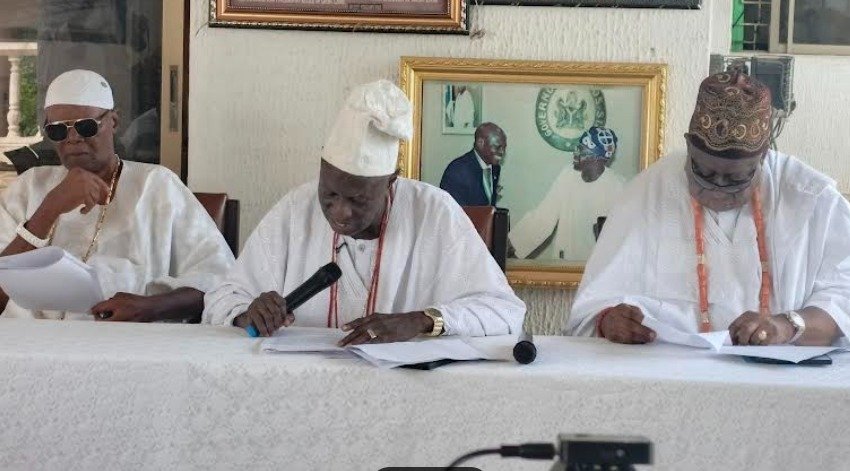


The Fusengbuwa Ruling House has instituted a suit at the High Court of Justice in Ijebu Ode against the Ogun State Government and the Awujale Afobaje Kingmakers Council over what it described as a prolonged delay in the selection of a successor to the late Awujale and Paramount Ruler of Ijebuland, Oba Sikiru Kayode Adetona.
The suit, marked HCJ/149/2026, was filed at the Ijebu Ode Judicial Division. The ruling house is seeking an order of the court to compel the nine-member kingmakers’ council to reconvene and conclude the selection process for the next Awujale without further delay.
In the suit, the Fusengbuwa Ruling House is also challenging the alleged lockdown of the Awujale Palace by the police.
According to the plaintiffs, the action was carried out on the instructions of the state government and was intended to halt the selection process.
Oba Adetona died on July 13, 2025, leaving the revered Ijebu throne vacant.
According to the court documents, the Ijebu Ode Local Government formally notified the Fusengbuwa Ruling House on December 2, 2025, that it was its turn to produce a candidate for the vacant stool, in accordance with the rotational arrangement recognised by the Obas and Chiefs’ Law of Ogun State 2021.
The ruling house subsequently commenced its nomination exercise, holding a meeting on January 12, 2026, within the 14-day period prescribed by Section 16(1)(b) of the law.
A total of 95 princes and princesses were reportedly nominated, with the complete list forwarded to the nine-member Awujale Afobaje Kingmakers Council on January 19 for the next stage of the process.
The council is chaired by Olor’gun Sonny Kuku, the Ogbeni Oja, and comprises Chief Rasheed Adesanya (Olisa), Chief Oluwaranti Lekan Osifeso (Olootu Olowa), Chief Jimi Lawal (Olootu Ifore), Chief Abimbola Okenla (Kakanfo Awujale), Chief Kunle Ogunade (Apebi), Chief Agboola Alausa (Balogun), Chief Adebisi Adaran, popularly known as Gbenden (Ogbeni Odi), and Chief Ayotunde Ola Odulaja (Lapoekun and Secretary).
The ruling house alleged that police officers entered the Awujale Palace shortly after midnight on January 20, preventing the kingmakers from proceeding with the selection of a preferred candidate.
The subsequent suspension of the process was reportedly attributed by the local government to security reports and allegations of bribery and financial inducement.
The claimants have disputed the allegations, insisting that no evidence or formal petition substantiating the claims was presented to them.
They further claimed that investigations by the police and the Department of State Services did not establish any wrongdoing.
The suit also names the Ijebu Ode Local Government Executive Chairman, Hon. Dare Alebiosu, who had earlier approved the commencement of the process, as well as the Commissioner for Local Government and Chieftaincy Affairs, Hon. Ganiyu Hamzat.
The ruling house alleged that Hamzat subsequently petitioned the Eleweeran Police Station in Abeokuta on February 2, 2026, requesting that the kingmakers and principal officers of the ruling house be invited for questioning.
In their reliefs before the court, the claimants are asking for a declaration that the nomination exercise conducted by the Fusengbuwa Ruling House was validly completed and that the kingmakers are legally required under Sections 16(1)(e) and (f) of the law to select a candidate from the submitted list and forward the name to the Ogun State Executive Council.
They are also seeking a declaration that the state government has no legal authority to arbitrarily suspend the selection process and an order directing the kingmakers to reconvene within seven days of judgment to complete the exercise.
The claimants further want an injunction restraining the state government and security agencies from interfering with the selection process.
Their counsel, led by Otunba Olusegun Otayemi, argued that the state’s chieftaincy law establishes a sequential process covering nomination, selection and approval, which, according to them, must be followed once lawfully initiated.
The legal team reportedly cited previous judicial decisions, including Menakaya v. Menakaya and Garba v. University of Maiduguri, in support of its arguments on statutory duties and fair hearing.