


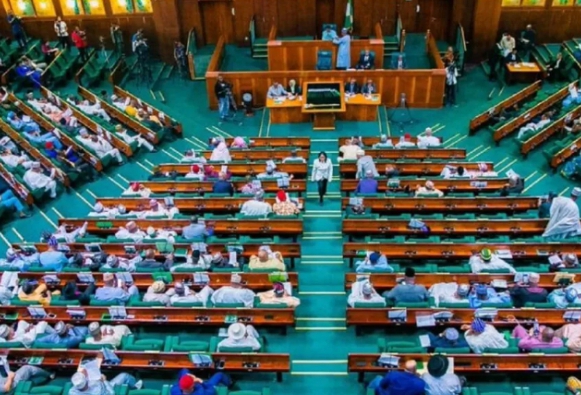


The House of Representatives, has directed its relevant committees to investigate the territorial status of Eba Island, a geographical area currently being contested by Ogun and Ondo states.
The resolution was sequel to the adoption of a motion at plenary moved by the member representing Odigbo/Ile-Oluji/Okeigbo Federal Constituency, Joseph Adegbesan.
Adegbesan,who presented the motion reminded the House that the National Boundary Commission is constitutionally empowered to define, adjust and maintain inter-state boundaries within the Federal Republic of Nigeria.
According to him, Eba Island, the site of a recently approved oil well for commercial drilling, is geographically located between the Oluwa and Alape rivers within Ogun Waterside Local Government Area of Ogun State.
“The House is aware that Eba Island, the site of a recently approved oil well for commercial drilling, is geographically situated between the Oluwa River and the Alape River within Ogun Waterside Local Government Area of Ogun State,” he added.
He revealed that there are two distinct locations bearing the name “Eba”, one being Eba Island in Ogun Waterside Local Government Area of Ogun State and the other an inland Eba community located in Ilaje Local Government Area of Ondo State.
The two locations are geographically and administratively separate, he said.
He further noted that the Independent National Electoral Commission (INEC) has, over the years, recognised Eba Island as part of Makun/Irokun Ward in Ogun Waterside Local Government Area of Ogun State by establishing polling units and conducting elections in the area.
He told the House that the Nigerian National Petroleum Company Limited (NNPC Ltd.), in conjunction with the Nigerian Upstream Petroleum Regulatory Commission (NUPRC), carried out due diligence and verified the coordinates of the oil well before approval was granted for commercial drilling.
“The House also observed that the Nigerian National Petroleum Company Limited, in conjunction with the Nigerian Upstream Petroleum Regulatory Commission, conducted due diligence and verified the coordinates of the oil well prior to the approval for commercial drilling by the President and Commander-in-Chief of the Armed Forces of the Federal Republic of Nigeria, Bola Tinubu,” he added.
The lawmaker expressed concern over recent claims suggesting that the oil-producing island falls within Ondo State, warning that such assertions could trigger unnecessary tension between the two neighbouring states.
The claims, he said, risk creating avoidable friction between Ogun and Ondo states and may undermine national economic stability.
He also raised concerns over reports of threats allegedly issued by some groups regarding the oil exploration activities in the area.
“We are disturbed that reports of threats issued by certain groups regarding the oil exploration activities pose potential risks to national security and economic infrastructure,” he said.
He further noted that there has been no constitutional amendment, judicial pronouncement, Federal Gazette, or formal boundary adjustment by the National Boundary Commission transferring Eba Island from Ogun State to Ondo State since the 1976 state creation exercise.
He added that confusion arising from the similarity in nomenclature between two different locations named “Eba” could mislead the public and policymakers.
He cautioned that unresolved territorial disputes over oil-bearing areas could discourage investment, disrupt exploration activities and threaten national revenue generation.
Following the adoption of the motion at a session presided over by the Deputy Speaker, Benjamin Kalu,
The House mandated its Committees on Special Duties and Petroleum Resources (Upstream) to investigate the geospatial coordinates and official boundary documentation relating to Eba Island and report back within four weeks for further legislative action.
The controversy surrounding Eba Island has heightened in recent weeks due to the approval for commercial oil drilling in the area, raising questions about which state has legal ownership of the territory and the attendant revenue benefits.
Both Ogun and Ondo states have been laying claim to the oil-bearing island, citing historical, administrative and geographical arguments to support their positions.