


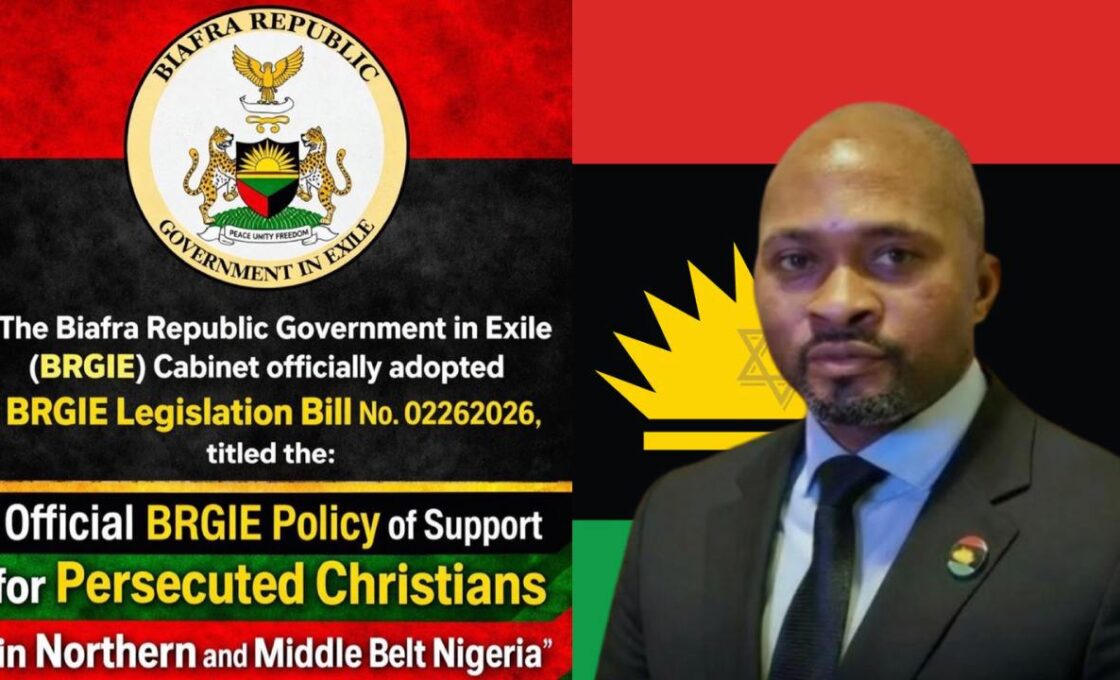


The Biafra Republic Government in Exile, has said Biafra after independence would be a safe haven for persecuted Christians in Northern and Middle Belt Nigeria.
The Prime Minister of BRGIE, Ogechukwu Nkere, disclosed this in a statement on Tuesday.
This comes as BRGIE passed legislation titled “BRGIE Policy of Support for Persecuted Christians in Northern and Middle Belt Nigeria.”
According to the group, Biafrans supported the move that would grant automatic citizenship to persecuted Christians in Northern and Middle Belt Nigeria who sought refuge in Biafra upon independence.
He stated that the leader of the Indigenous People of Biafra, Nnamdi Kanu, had initially nursed the policy but it has been codified by BRGIE.
He said:”Biafra Republic Government in Exile Passes Legislation Establishing Alliance with Protection for Middle Belt and Northern Nigerian Christians.
“On February 27, 2026, the Biafra Republic Government in Exile (BRGIE) officially adopted BRGIE Legislation Bill No. 02262026, titled “Official BRGIE Policy of Support for Persecuted Christians in Northern and Middle Belt Nigeria.” BRGIE Prime Minister Ogechukwu Nkere strongly supported the legislation and presided over the vote.
“This legislation establishes a formal policy under which BRGIE, upon the attainment of Biafran independence, will provide safe haven to Christians from Northern Nigeria who seek refuge in Biafra. The policy includes the granting of automatic Biafran citizenship to such individuals upon independence. While Mazi Nnamdi Kanu previously referenced this concept informally, BRGIE has now codified the principle into official policy and law. In a manner analogous to how Israel serves as a homeland and refuge for Jewish people worldwide, an independent Biafra would serve as a safe haven for Christians in West Africa.
“The legislation further articulates a policy of support for Christian communities in Nigeria’s Middle Belt through political engagement, humanitarian assistance, and lawful defensive cooperation. This framework envisions the development of strategic partnerships aimed at strengthening community self-defense capacity and countering extremist threats, including Boko Haram and the Islamic State West Africa Province (ISWAP), in full compliance with international law and human rights standards.
“Through these policies, an independent Biafra would not only safeguard the security and sovereignty of its own citizens but also act as a stabilizing force and source of protection for vulnerable Christian populations in Northern Nigeria and the Middle Belt. BRGIE reassures international partners—including stakeholders within the United States government—that Biafran independence would contribute to regional security, humanitarian protection, and broader stability.
“BRGIE adopted this policy in light of advice and encouragement from senior U.S. officials. It is incumbent upon BRGIE to demonstrate seriousness of purpose and institutional preparedness by addressing the practical and humanitarian implications of a potential path toward independence.
“One of the principal concerns raised by certain U.S. officials relates to the fate of Christians who would remain in Northern Nigeria and the Middle Belt in the event of Biafran independence. This concern is legitimate. Should Biafra secede, the remainder of Nigeria could potentially evolve in a more Islamist direction, thereby increasing the vulnerability of Christians to marginalization, persecution, or even mass atrocities. By enacting this legislation and formalizing its policy of support for Middle Belt and Northern Nigerian Christians, BRGIE directly addresses these concerns.
“Supporters of Biafran self-determination, including Dr. Walid Phares, a former senior foreign policy adviser to President Trump, have encouraged Biafrans to collaborate with and support Christian communities in the Middle Belt and Northern Nigeria.
“Accordingly, it is imperative that the Biafra Republic Government in Exile formalize and implement a comprehensive policy framework that addresses these concerns and advances constructive, lawful, and humanitarian solutions for the protection and advancement of Christian populations in the region,” he stated.
A United States lawmaker, Riley Moore barely a week ago presented a report on the persecution of Christians in Nigeria to President Donald Trump at the White House.
The lawmaker, alongside other members of the US delegation, had visited Nigeria on a fact-finding mission.
President Trump, after designating Nigeria as a country of concern over an alleged persecution of Christians, had ordered airstrikes against terrorists in Sokoto, Northern Nigeria, on December 26, 2026.