


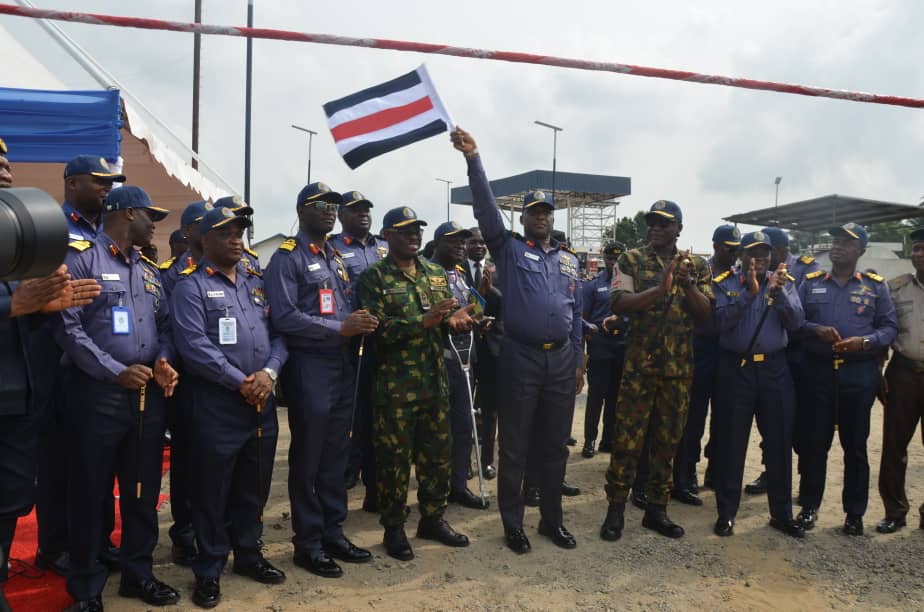


The Nigerian Navy has launched Operation Delta Sentinel, a new security initiative aimed at tightening maritime security in the Niger Delta and supporting increased oil production.
The operation replaces Operation Delta Sanity and aligns with the Federal Government’s drive to ramp up crude oil exploration and output to 2.5 million barrels per day by 2027.
It also marks a significant step in the Navy’s efforts to protect critical economic assets, strengthen the national economy, and sustain peace and stability in the Niger Delta.
At the launch ceremony at the Nigerian Navy Ship (NNS) Pathfinder Jetty in Port Harcourt, Rivers State, on Tuesday, the Commander Task Group 26.1, Operation Delta Sentinel, Rear Admiral Sulieman Ibrahim, said the operation would run for one year, subject to renewal every 90 days.
Rear Admiral Ibrahim, said the Navy remains resolute in denying criminal elements freedom of action, securing vital national oil infrastructure, and contributing to lasting peace in the region.
He explained that Operation Delta Sentinel would be driven by enhanced inter-agency coordination, intelligence-led operations, and close collaboration with regulators, sister services, security agencies, state governments, and other stakeholders.
The Navy, he said, will deploy maritime domain awareness infrastructure, new maritime platforms, as well as manned and unmanned air assets to improve situational awareness and optimize operational effectiveness.
According to him, sustained naval operations have already yielded results, with crude oil losses dropping by 90 per cent, from 102,900 barrels per day in 2021 to 9,600 barrels per day as of September 25.
He said: “The transformation from Operation Delta Sanity II to Operation Delta Sentinel is necessitated among other considerations, by the Federal Government drive to increased oil exploration and production.
“Hence, the need to infuse more vigour into preventing crude oil theft and increase oil production in line with the Nigerian Upstream Petroleum Regulatory Commission (NUPRC), “Project 1m bpd initiative.
“It is further anticipated that oil production would be about 2.5m bpd by 2027. The divestments of IOC investor portfolio re-ordering to focus on deep offshore development would be closely supported by the Nigerian Navy,” he added.
Rear Admiral Ibrahim expressed gratitude to the Chief of the Naval Staff for the appointment and pledged that Operation Delta Sentinel would fully deliver on its mandate.
He said the operation would adopt a deliberate, innovative, and technology-driven approach, anchored on the effective use of Maritime Domain Awareness infrastructure, modern maritime platforms, and both manned and unmanned air assets.
He noted that these capabilities will enhance asset utilization, strengthen situational awareness, and sustain a proactive surveillance and response posture.
He said, “Our approach will be deliberate, innovative, and technology-enabled. In this regard, the effective employment of Maritime Domain Awareness infrastructure, new maritime platforms as well as manned and unmanned air assets will remain central to our surveillance and response architecture. These capabilities will enable us to optimize asset utilisation, improve situational awareness, and maintain a proactive operational posture.
“I wish to state unequivocally that the Task Group 26.1 is fully prepared to execute this mandate with firmness, professionalism and resolve. Our objective is clear and unambiguous: to deny criminal elements freedom of action, protect critical national Oil assets, support legitimate economic activities and contribute to enduring peace and stability in the Niger Delta.”
Earlier in his remarks, the Flag Officer Commanding (FOC), Eastern Naval Command, Rear Admiral Chiedozie Okehie, said Operation Delta Sanity II, flagged off on December 30, 2024 was designed to decisively curb crude oil theft, illegal bunkering, pipeline vandalism, and related maritime crimes within Nigeria’s maritime domain.
He noted that before its termination, the operation recorded notable successes, including the arrest of 203 suspects, the deactivation of 324 illegal refining sites, and the seizure of stolen crude oil and other petroleum products valued at over ₦3.65 billion.
Rear Admiral Okehie, who also served as Commander, Task Group 25.1 of Operation Delta Sanity II, said the Nigerian Navy’s sustained operations contributed to a marked reduction in crude oil losses.
He mentioned figures from the Nigerian Upstream Petroleum Regulatory Commission (NUPRC), which showed that losses dropped to their lowest level since 2009 in September 2025.
Rear Admiral Okehie described Operation Delta Sanity II as meeting its objectives and making measurable contributions to national security and economic stability.
The achievements of the operation, he said, were driven by the effective integration of the Nigerian Navy’s Maritime Domain Awareness architecture, intelligence-led and kinetic operations executed by naval personnel, as well as strengthened collaboration with sister security agencies, maritime regulators, oil industry stakeholders, and host communities.
“These were further strengthened by non-kinetic engagements including medical outreach programmes, media sensitisation, educational activities and community engagements, which helped to deepen trust and cooperation at the grassroots level.
“During the period under review, from 1 January to 31 December 2025, the operational outcomes were both substantial and impactful. A total of 203 suspects were arrested, while 324 illegal refining sites were deactivated in accordance with extant regulations.
Rear Admiral Okehie said an estimated 3,780,321.25 litres of stolen crude oil, 1,096,815 litres of illegally refined automotive gas oil (AGO), 86,210 litres of premium motor spirit (PMS), and 74,300 litres of kerosene were seized and appropriately handled.
He disclosed that 91 wooden boats, 1,379 dugout pits, 732 ovens, 411 reservoirs, 121 storage tanks, and seven vessels were arrested or deactivated, along with several other items and equipment used in the construction and operation of illegal refining facilities.