

Please share


The Federal Government has said that the Petroleum Industry Bill would resolve all the legal and regulatory challenges in the nation’s oil and gas industry once it is signed into law.
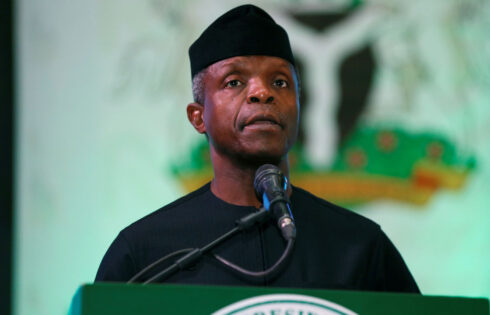
Vice President,Yemi Osinbajo,who gave the optimism at the official opening ceremony of the 2021 Nigeria Oil and Gas Conference (NOGC) in Abuja,was represented at the event by the Minister of State for Petroleum Resources, Timipre Sylva.
He said the global lockdown triggered by the pandemic pushed a transforming industry into a state of major economy crisis and further amplified the global clamour for cleaner and more sustainable renewable energy.
He added that the critical assessment of the nation’s perspective for Nigeria’s preparedness for oil and gas industry stability and growth in the wake of energy transition dynamics cannot be over-emphasized.
According to him,the future survival and success of many players in the industry will not only depend on their ability to achieving greater focus on cleaner energy source, but also upon the ability to deliver low cost solutions.
He said:“Consequently, the government is encouraging our industry players to critically focus on our vast natural gas resources as a transition period that will function as a bridge between the dominant fossil fuel of today and cleaner energy of tomorrow. Natural gas has the ability to meet the increasing global requirements for cleaner primary energy use while at the same time, enabling much needed domestic industrialisation for rapid economic growth in very few endowed countries such as Nigeria.
“Government is not unmindful of the peculiar challenges confronting the gains of oil and gas operations in Nigeria; from infrastructural deficiency and insecurity to high cost of operations to mention just a few.The government is working consciously to tackle all without lagging behind on our path to meeting the global demand that our signatory to international protocols of cleaner energy have placed on us. We must have noticed that despite the current global challenges in the industry, the Government has been supporting the aggressive implementation of the nationwide gas infrastructure blueprint.”
In his remarks,the Group Managing Director, Nigerian National Petroleum Corporation (NNPC),Mallam Mele Kyari, lamented the challenge facing the oil and gas industry, saying investments in the sector has dropped to 30 percent.
He said the implications of the drop occasioned by global challenges, would begin to manifest within the next three to five years,adding that finances for fossil fuel investments were dwindling due to energy transition and as a result, Nigeria and other developing economies would have to depend on hydrocarbon resources to power their economies.
He said: “This industry is very challenged today, the investment has gone down 30 percent so those outcomes will come up probably in the next three, four, five years when we will realise that the lack of investment today will manifest in all practical sense, in our inability to meet demand requirements of oil and gas in the industry.
“Even if we have, unless something happens and there is a catch up period, there is something we can do as an industry but we know that if we don’t do anything, something will happen.
“Energy transition is not about movement from fossil fuel to renewable, its creating the right balance and there is this common mistake that in 2050, fossil fuel will go away and we will be dealing with renewables. That is not true, it is very far from the truth.
“For us as a developing country, energy resource dependent county, we know for sure that beyond 2050 that oil will be relevant for us. Today we are in deficit of infrastructure, power and many other things but so much good works are going on but the fact remains that there is deficit here.
“All the engagements around electric vehicle even in terms of carbon zero objective probably is very questionable if even is the solution to carbon zero emission so many things are happening.
“Post realities will come up in the next five years and we will have to deal with it but for us we know for sure that things have changed; financial institutions have changed their priorities, some of them have stopped lending to energy borrowings etc.
“Yes it may be for the moment, they may come back to the realities probably in another five years but the reality today is you can’t find easy financing for fossil fuel related businesses.”
The NNPC boss who further noted the demand for crude oil was still and would still be there by 2050 despite the energy transition policy, disclosed that operators in the oil and gas sector have begun to focus on quick oil.
“For every forecast that we have including from update from very many other institutions that are not in this business, every body says even if by 2050 we still have oil demand of about 100 million barrels so what you will see is growth.
“We are still at about 95 and 96 today but if we’re still at 100 by year 2050, it means that the growth is very small but there will still be 100 million barrels production on the ground so the position we are taking as the national oil industry and also as an industry, in this country is to produce the quick oil.
“Quick oil means that we have to monitor every resources that is available today, so we will create the resources that will create a future for our country and for our businesses and the oil will provide that fulcrum for us to create the wealth but one thing we are also sure, is that gas is everything.”
Meanwhile,Vice President Yemi Osinbajo has said there is a projection that Nigeria’s leather industry has the potential to generate over $1 billion by 2025.
He disclosed this at the formal inauguration and sensitisation workshop on the National Leather and Leather Products Policy Implementation Plan on Tuesday in Abuja,where he also said leather value chain had created wealth and appreciable job opportunities in Nigeria.
He said:“Nigeria is one of the highest producers of leather and finished leather products in Africa; a study carried out by the Nigerian Economic Summit Group (NESG) projected that the Nigerian leather industry has the potential to generate over 1 billion dollars by 2025.The leather value chain is extensive; it includes animal husbandry, tanneries, finished leather products and leather products marketing.
“The leather and leather products industry currently employs over 750,000 workers with about 500,000 workers in the finished leather goods sector.About eleven leather exporting companies have been active at the upstream end of the leather value chain; together, these companies generate about 8000 jobs.’’
According to him, the export of leather had grown steadily reaching a peak of 117 million dollars in 2018 but fell in 2020 largely due to the COVID-19 pandemic.
Osinbajo said that Nigeria’s leather products and value chain had immense potential and attracted huge international patronage.
He added:“To date, however, exports are in the order of 272 million dollars; today, Nigeria’s semi-finished and finished leather have their highest patronage in Italy, Spain, India, South Asia and China.Shoes, belts, bags and folders are largely traded in West Africa and many parts of Africa.
“Anecdotal evidence suggests that the famous Aba shoe cluster in Abia, informally exports almost a million pairs of shoes weekly mostly to destinations within Africa.The industry is huge and its potential can only be imagined; so, there is no question that properly organised, the leather and leather products industry could become one of the major items in Nigeria’s export basket.’’
According to him, there is clearly an enormous potential for greater job opportunities and much higher export proceeds.
He said that the NESG projection also indicated that the Nigerian leather industry had the potential to increase its earnings by 70 per cent by 2025.
“This explains why the launch of the National Leather and Leather Products Policy Implementation Plan is such an exciting development.We now have a real opportunity to address the specific challenges and shortcomings of the leather sector with pragmatic strategies to permanently resolve these issues for optimal productivity.
“In particular, there is now a clear line of sight to our emergence as a major hub for the manufacture of leather goods with the refocusing of the leather sector to value addition from its previous focus on exporting semi-processed leather.A major part of that effort is improving access to credit for leather products manufacturers.’’
He said that the plan provided an opportunity to develop a credit guarantee scheme along the lines of the successful agricultural credit guarantee scheme.
Osinbajo said that more intentional infrastructure development had become possible.
“Our Special Economic Zones (SEZ) project already projected leather products manufacturing as a major focus, synergy and collaboration with Nigeria Export Processing Zones Authority (NEPZA) was all required at present.
“By optimising the value chain, the sector will provide employment, improve our foreign exchange earnings and boost growth.
“Consequently, it is evident that in terms of what we have set out to do through the policy and the implementation plan, the stakes are very high.
“The plan covers eight thematic areas including intellectual property rights, governance, E-leather, environmental and social best practices, marketing, funding, critical infrastructure and research and development.
“The plan is as all-encompassing as it is detailed; relevant MDAs, NGOs and the organised private sector are assigned specific responsibilities for the various objectives, and strategies of the plan.’’
He said that a central feature of the plan was the development of technical capacity in leather works and technology.
Please share